
The ROI of Web Accessibility

TABLE OF CONTENTS
- Executive Summary
- 2025 Key Statistics at a Glance
- The Business Case for Accessibility in 2025
- The Disability Market: A $13 Trillion Opportunity
- 2025 Legal & Regulatory Landscape
- Accessibility Market Growth & Industry Analysis
- AI & Emerging Technology Impact
- 2030 Forecast & Predictions
- Strategic Recommendations
- Conclusion
2025 Market Analysis & 2030 Forecast
Updated December 2025
Executive Summary
Web accessibility has evolved from an ethical consideration to a critical business imperative. In 2025, the convergence of escalating litigation, expanding global regulations, and a $13 trillion disability market has transformed accessibility from a compliance checkbox into a strategic competitive advantage.
This report examines the current state of digital accessibility, quantifies its return on investment, and provides forward-looking analysis through 2030. Key findings reveal that organizations investing in proactive accessibility strategies realize significant returns while those ignoring these requirements face mounting legal and financial exposure.
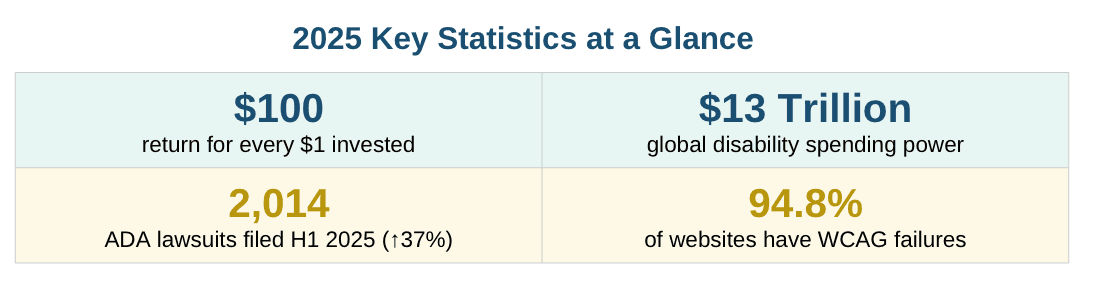
2025 Key Statistics at a Glance
The Business Case for Accessibility in 2025
Conversion Rate Impact
Accessibility directly influences conversion performance through multiple mechanisms. Research shows accessible sites achieve dramatically lower cart abandonment rates. Several factors drive these improvements:
- Lower cart abandonment: 23% on accessible sites versus 69% on inaccessible sites
- Higher sales: Accessible e-commerce sites see 15% higher sales on average
- Increased traffic: Websites using accessibility guidelines see 18% year-over-year traffic increases
- Reduced bounce rates: Accessibility improvements reduce bounce rates by 30%
- Better retention: 40% of businesses report improved customer retention after accessibility improvements
Marketing & SEO Benefits
The Web Content Accessibility Guidelines (WCAG) align closely with search engine optimization best practices. Many WCAG requirements directly improve SEO performance:
- Descriptive page titles and meta descriptions improve both accessibility and search rankings
- Alt text for images helps screen reader users and enables image search indexing
- Semantic HTML structure improves content discoverability and assistive technology compatibility
- Video captions and transcripts increase engagement by 41% and improve brand recall by 16%
Additionally, 77% of organizations report increased brand reputation after implementing accessibility improvements, creating valuable earned media and word-of-mouth marketing.
Operational Cost Reduction
Beyond revenue enhancement, accessibility delivers significant cost savings:
- Reduced customer support costs: User-friendly, accessible websites reduce support ticket volume
- Lower development costs: Well-structured, accessible code is easier and less expensive to maintain long-term
- Legal cost avoidance: Proactive compliance prevents expensive litigation and settlements (average settlements now exceed $50,000)
The Disability Market: A $13 Trillion Opportunity
Global Market Size
The World Health Organization estimates that over 1.3 billion people—approximately 16% of the global population—experience some form of disability. This community, together with their friends and family, controls an estimated $13 trillion in annual spending power globally.
In the United States alone, 26% of adults (61 million people) have a disability. This demographic controls $490 billion in disposable income—comparable to other major market segments like African Americans ($501 billion) and Hispanics ($582 billion).
Consumer Behavior Insights
Research reveals powerful insights about disability consumer behavior:
- 71% of people with disabilities will immediately leave a website that presents access barriers
- 54% of disabled consumers are more likely to favor companies that represent disability authentically
- Consumer companies lose $6.9 billion annually because inaccessible websites drive customers with disabilities to competitors (McKinsey)
- Only 2% of disabled consumers feel accurately portrayed in media and marketing—representing a significant differentiation opportunity
The Extended Market
The disability market extends beyond individuals with permanent disabilities to include:
- Aging populations: By 2030, 1 in 6 people globally will be over 60. Age-related changes affect vision, hearing, cognition, and mobility
- Situational impairments: Users in bright sunlight, noisy environments, or using one hand benefit from accessible design
- Temporary disabilities: Broken limbs, recovery from surgery, or temporary vision issues affect millions annually
The friends and family of people with disabilities add another 2.9 billion individuals globally, bringing total extended market spending power to over $15 trillion in Canada, the EU, UK, and US alone.
2025 Legal & Regulatory Landscape
U.S. Litigation Explosion
ADA website accessibility lawsuits surged 37% in the first half of 2025, with 2,014 cases filed between January and June. This trajectory suggests approximately 4,000-5,000 total lawsuits by year-end. Key litigation trends include:
- Geographic expansion: New York (637), Florida (487), California (380), and Illinois (237, up 746% from 2024) lead filings
- Industry concentration: Restaurants/Food & Beverage (30.5%), Fashion/Apparel (28.8%), and e-commerce broadly (69% of all lawsuits)
- Widget failures: 22.6% of lawsuits (456 cases) targeted websites using accessibility widgets/overlays
- Plaintiff concentration: Just 31 plaintiffs and 16 law firms account for 50% of all cases
- Enterprise targeting: 36% of sued companies have revenue exceeding $25 million (up from 33% in 2024)
FTC Enforcement Action
In January 2025, the Federal Trade Commission ordered accessiBe to pay $1 million for misleading claims about its automated accessibility remediation tool. This enforcement action confirmed what accessibility professionals have long warned: overlay widgets are not compliance solutions and may actually increase legal exposure.
European Accessibility Act (EAA)
Effective June 28, 2025, the European Accessibility Act represents the most significant expansion of digital accessibility requirements globally. Key provisions include:
- Scope: E-commerce, banking, transportation, e-books, and all consumer-facing digital services
- Applicability: Any business serving EU customers, regardless of where they are headquartered
- Penalties: Fines up to €500,000 or more depending on member state, plus public notices and potential market bans
- Standards: EN 301 549 (based on WCAG 2.1 AA), with future harmonization to WCAG 2.2
U.S. Federal Requirements
The Department of Justice's ADA Title II final rule, announced in April 2024, requires state and local governments to conform to WCAG 2.1 Level AA by April 2026. This creates compliance pressure throughout public sector supply chains and vendors.
Accessibility Market Growth & Industry Analysis
Software Market Projections
Market Segment2025 Size2030 ProjectionDigital Accessibility Software$768-800 million$1.08-1.3 billionAccessibility Testing Market$610 million$801 millionAssistive Technology Market$26.4 billion$43.9 billionWebsite Accessibility Software$10.5 billion$18.7 billion
Sources: Grand View Research, Mordor Intelligence, Research and Markets, Verified Market Reports (2025)
Current Website Compliance Status
Despite growing awareness, compliance remains staggeringly low:
- 94.8% of home pages have detected WCAG 2 failures (WebAIM Million 2025)
- Average of 56.8 errors per homepage across the top 1 million websites
- Only 3.1% improvement in detectable failures over the past 6 years
- Most common errors: Low contrast text (81%), missing alt text (54.5%), missing form labels (48.6%)
This compliance gap represents both significant legal risk and enormous market opportunity for organizations willing to invest in accessibility.
AI & Emerging Technology Impact
AI-Powered Accessibility Tools
Artificial intelligence is transforming accessibility capabilities in 2025:
- Automated image descriptions: AI generates accurate alt text at scale, reducing manual effort
- Real-time captioning: Live translation and captioning in 100+ languages available across platforms
- Enhanced detection: Computer vision improves scanning efficiency, though automated tools still detect only ~30% of WCAG issues
- Predictive analytics: AI anticipates user needs and adapts interfaces in real-time
Critical Limitations
Despite AI advances, significant limitations remain:
- Only 7% of disabled respondents believe their communities are adequately represented in AI product development
- Automated tools detect only ~30% of WCAG issues; manual testing by experts remains essential
- Overlay widgets proven ineffective: FTC enforcement and 456 lawsuits against widget-using sites confirm widgets don't prevent litigation
The most effective approach combines AI-powered automation with human expertise, enabling organizations to detect issues at scale while addressing complex, context-specific barriers requiring manual intervention.
2030 Forecast & Predictions
Regulatory Evolution
- WCAG 3.0 Expected Finalization (2028-2030): The new standard introduces outcome-based requirements, Bronze/Silver/Gold conformance levels, and expanded cognitive accessibility criteria
- Global Standard Harmonization: EN 301 549 (EU), Section 508 (US), and regional standards converging on WCAG, simplifying multinational compliance
- Expanded Scope: XR/VR, voice interfaces, IoT devices, and AI-generated content brought under accessibility mandates
- Procurement Requirements: Government and enterprise contracts increasingly requiring vendor accessibility attestations throughout supply chains
Technology Predictions
- Shift-Left Movement: Accessibility testing moves earlier in development lifecycle, from post-launch auditing to development-time prevention
- Multimodal AI Integration: AI systems processing text, images, audio, and video simultaneously will enable real-time adaptive interfaces
- Wearable Accessibility: Smart glasses and haptic devices provide richer, more interactive experiences for people with disabilities
- Edge AI Accessibility: On-device processing enables accessibility features in areas without reliable internet
Market Outlook
By 2030, accessibility is projected to become a normalized business requirement similar to security—no longer a differentiator but a baseline expectation. Organizations that build accessibility into their DNA today will be positioned as industry leaders, while those that delay will face increasing costs to catch up.
The global accessibility market is projected to reach $2-3 billion by 2030, with AI contributing up to $15.7 trillion to the global economy broadly. First-mover organizations achieving accessibility excellence while competitors struggle will gain meaningful competitive differentiation.
Strategic Recommendations
Immediate Actions (2025-2026)
- Conduct comprehensive WCAG 2.2 AA audit: Manual testing by qualified experts, not just automated scans
- Prioritize code-level remediation: Avoid overlay widgets—they don't prevent litigation and may increase exposure
- Implement continuous monitoring: Accessibility degrades over time; regular testing catches issues before they become lawsuits
- Publish accessibility statement: Demonstrate commitment and provide feedback mechanisms
- Train development teams: Shift-left by building accessibility skills across your organization
Medium-Term Strategy (2026-2028)
- Integrate accessibility into CI/CD pipelines: Automated testing catches issues before deployment
- Establish user testing programs: Include people with disabilities in QA processes
- Prepare for EAA compliance: If serving EU customers, ensure EN 301 549 conformance
- Begin WCAG 3.0 preparation: Monitor draft guidelines and pilot outcome-based testing
Long-Term Vision (2028-2030)
- Achieve accessibility maturity: Move from compliance mindset to inclusive design culture
- Target WCAG 3.0 Silver/Gold: Position as industry leader in inclusive experiences
- Leverage accessibility for innovation: Curb cuts, voice interfaces, and captions all began as accessibility features
- Capture disability market share: Differentiate by authentically serving the $13 trillion market
Conclusion
The ROI of web accessibility has never been clearer. With $100 returned for every $1 invested, access to a $13 trillion market, and mounting legal exposure for non-compliance, accessibility represents both a moral imperative and a strategic business opportunity.
Organizations that prioritize accessible design today will enjoy stronger conversion rates, better SEO performance, reduced operating costs, and protection from litigation. More importantly, they will be positioned to serve the fastest-growing consumer segment as global populations age and digital dependency increases.
The question is no longer whether to invest in accessibility, but how quickly organizations can build inclusive design into their DNA. The leaders of 2030 are making those investments today.
Stay informed
Accessibility insights delivered
straight to your inbox.


Automate the software work for accessibility compliance, end-to-end.
Empowering businesses with seamless digital accessibility solutions—simple, inclusive, effective.
Book a Demo